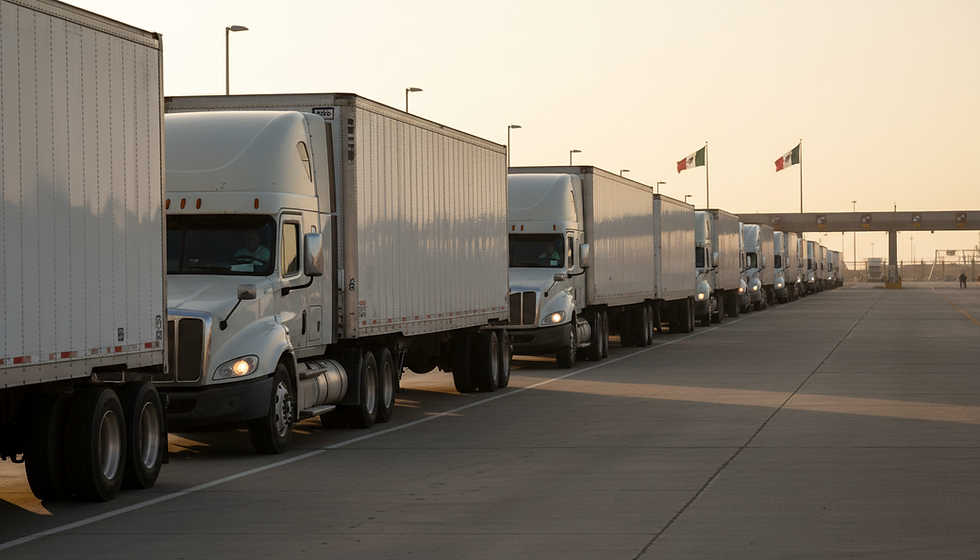
US Mexico USMCA Talks Ahead Can an Interim Deal Deliver Before Midterms

Updated: Sep 24
A new round of U.S.-Mexico trade talks is set for next week, and the timing matters as much as the substance. With the U.S. midterm elections approaching, both governments have a clear reason to show progress fast: Washington wants a policy win it can sell to voters, while Mexico wants trade certainty before political pressure makes compromise harder.
The talks arrive at a tense point for North American trade. Discussions with Canada have stalled, at least for now, while Mexico appears more willing to keep moving. That opens the door to an interim U.S.-Mexico arrangement- that could settle key issues between the two countries, reduce uncertainty for manufacturers and farmers, and create momentum for a broader USMCA solution later.
The question is whether a bilateral step can do enough, quickly enough, without weakening the larger trilateral framework that has governed trade across North America.

Why next week’s talks carry unusual urgency
Trade negotiations often move slowly. Technical language, dispute rules, quotas, tariffs, labor standards, and rules of origin can take months to settle. This round has a different clock.
The White House faces the political reality of the midterm campaign season. A trade announcement before voters go to the polls would give President Donald J. Trump a concrete message: his administration is pressing for better terms, protecting U.S. industry, and forcing movement from trading partners.
Mexico has its own reason to accelerate. A long delay could leave businesses guessing about tariffs, sourcing rules, and cross-border supply chains. That uncertainty affects investment decisions in sectors that depend on North American integration, including autos, agriculture, appliances, energy, and consumer goods.
Both sides also know that a partial deal can be easier to finish than a full three-country agreement. If the most difficult Canada-related issues remain unresolved, Washington and Mexico City may prefer to bank progress where they can.
That political and economic pressure explains why next week’s talks are drawing so much attention. They are not just another meeting. They could determine whether negotiators can turn months of debate into a visible outcome before the political window narrows.
Canada’s stalled position changes the negotiating map
A fully comprehensive USMCA result still needs Canada. The region’s trade rules work best when the United States, Mexico, and Canada move together, especially in industries where parts and products cross borders several times before reaching the final buyer.
Yet stalled talks with Canada have created a practical problem. If one partner is not ready to close, should the other two wait?
Mexico’s eagerness to proceed suggests the answer may be no, at least in the short term. A U.S.-Mexico interim deal would not replace a complete North American agreement. It would serve as a bridge, giving both countries a chance to lock in areas of agreement while leaving space for Canada to rejoin the process.
That approach has risks. Canada could view a bilateral arrangement as pressure, not partnership. Businesses that operate across all three countries could also face a patchwork of rules if the interim agreement is too narrow or unclear.
Still, politics often rewards movement. If the choice is between no agreement and a two-country framework that resolves some disputes, the United States and Mexico may decide that progress is better than deadlock.
The key test will be whether the interim deal is designed as a building block, not an off-ramp from trilateral trade.
What a bilateral agreement could deliver for the United States and Mexico
A U.S.-Mexico deal could produce benefits on both sides, even if it falls short of a final USMCA-wide settlement.
For the United States, the main benefit would be certainty for industries tied to Mexican suppliers and buyers. Mexico is one of America’s largest trading partners. U.S. farmers, automakers, machinery producers, energy companies, and retailers all depend on predictable rules at the border.
For Mexico, the benefit is just as clear. Access to the U.S. market remains central to Mexican manufacturing and export growth. A deal that preserves that access, even on an interim basis, would help reduce concern among investors and exporters.
The biggest areas of value would likely include:
Automotive trade
Clearer rules can help carmakers and parts suppliers plan production. The auto sector is one of the most integrated industries in North America, so even small changes can affect costs.
Agricultural access
Farmers and food producers benefit when border rules are stable. Disruptions can leave products stuck, raise costs, or push buyers toward other suppliers.
Manufacturing supply chains
Many U.S. companies rely on Mexican plants for parts, assembly, or finished goods. Uncertainty can slow orders and delay investment.
Customs and border procedures
Faster, clearer processes can reduce shipping delays. That matters for perishable goods, factory inputs, and time-sensitive deliveries.
Labor and compliance standards
A deal could reinforce commitments meant to address wage, workplace, and enforcement concerns, especially in politically sensitive industries.
A bilateral step would also show that the two countries can still solve trade disputes through negotiation rather than tariff escalation. That matters because tariffs can quickly become a blunt tool. They may pressure governments, but they also raise costs for businesses and consumers.

Why the White House would see a deal as a political win
For President Trump, an interim deal with Mexico could offer a clear campaign-season message. Trade has long been central to his political brand. He has argued that previous agreements gave too much away and that tougher negotiation can bring better terms for American workers and companies.
A deal before the midterms would allow the White House to claim several wins at once.
First, it would show movement on a high-profile economic issue. Trade policy can seem abstract, but it becomes politically powerful when tied to jobs, factories, farms, border security, and prices.
Second, it would let the administration argue that pressure worked. If Canada remains outside the immediate agreement, Trump could frame the U.S.-Mexico breakthrough as proof that partners who are ready to compromise can move ahead.
Third, it would create a contrast with gridlock. Midterm campaigns often reward simple messages. “We got a deal” is easier to sell than “negotiations continue.”
That does not mean the politics are risk-free. Critics may argue that an interim agreement is incomplete, that it sidelines Canada, or that it gives the White House a headline without solving deeper trade problems. Labor groups may examine whether enforcement provisions have real force. Businesses may worry about whether a two-country agreement creates confusion.
Still, from a political standpoint, a signed framework or announced breakthrough would give the administration something tangible. In an election season, that can matter nearly as much as the fine print.
The consumer impact will depend on pricing, tariffs, and supply chains
For American consumers, the most immediate question is simple: will a deal make prices lower, higher, or more stable?
The honest answer is that an interim U.S.-Mexico agreement would likely affect prices indirectly. Trade deals rarely cut grocery bills or car prices overnight. They shape the cost structure behind those prices.
If the talks reduce the risk of tariffs, border delays, or supply chain disruptions, consumers could benefit through more stable prices. Companies would have less need to build extra risk into pricing. Retailers and manufacturers could plan inventory with more confidence.
By contrast, if negotiations break down and tariffs increase, consumers could feel the pressure. Import taxes often get passed along, at least in part, through higher prices on goods. That can affect products with cross-border supply chains, including vehicles, appliances, electronics, food items, and household goods.
A deal could help hold the line on pricing in several ways:
It could reduce uncertainty for importers and retailers.
It could lower the risk of sudden tariff costs.
It could keep goods moving more smoothly across the border.
It could support stable sourcing for U.S. manufacturers that use Mexican inputs.
Consumers may not see a line on a receipt that says “trade agreement savings.” The effect is usually quieter. Prices may rise less than they would have under a trade fight. Product availability may remain steadier. Big-ticket goods with complex supply chains may avoid sharper cost shocks.
That makes the consumer impact politically useful but hard to prove. The White House can argue that a deal protects household budgets. Opponents can argue that any benefit is uncertain. Both sides will try to claim the pricing narrative because inflation and cost of living remain powerful election issues.

The interim deal must avoid creating a split North American market
The strongest case for a temporary U.S.-Mexico agreement is that it can keep talks moving. The strongest concern is that it might create a divided system.
North American trade is not just bilateral. A car assembled in Mexico may include parts from the United States and Canada. A food producer in the United States may depend on packaging from one country and distribution through another. Energy, metals, machinery, and chemicals often move through integrated regional networks.
If the U.S. and Mexico create rules that do not align with a future Canada-inclusive agreement, companies could face confusion. They might need to comply with one set of rules for U.S.-Mexico trade and another for goods involving Canada. That would raise costs and weaken the promise of regional certainty.
To avoid that problem, negotiators need to make the interim deal clearly compatible with a broader USMCA outcome. That means the agreement should focus on areas where the United States and Mexico can settle terms without closing the door on Canada.
A smart interim framework would likely include:
A useful interim deal should do this | It should avoid this |
Clarify agreed rules between the United States and Mexico | Create standards that Canada cannot realistically join |
Reduce tariff risk and border uncertainty | Add new compliance burdens for regional supply chains |
Protect space for a trilateral agreement | Turn a temporary step into a permanent split |
Give businesses near-term guidance | Leave major industries guessing about future rules |
This is why the language around the agreement matters. If officials describe it as a bridge to a full North American framework, businesses may welcome it. If they describe it as a substitute for a three-country deal, concern will grow.
Mexico’s eagerness reflects economic strategy, not just diplomacy
Mexico’s willingness to move ahead is not only a negotiating tactic. It reflects Mexico’s broader economic position.
The country benefits when companies see it as a stable base for production tied to the U.S. market. Manufacturers often choose Mexico because of geography, trade access, skilled labor, and existing supplier networks. Any doubt about the rules governing U.S.-Mexico trade can slow decisions on new plants, hiring, and supplier contracts.
A near-term deal could help Mexico send a message to investors: North American trade remains viable, even if talks with Canada take longer.
It could also help Mexico avoid being caught between larger political forces in Washington. When U.S. election campaigns heat up, trade debates often get sharper. By moving before the midterms, Mexican negotiators may believe they can secure better terms than they would during or after a more volatile campaign season.
That creates an unusual overlap of interests. The Trump administration wants a win before voters make their midterm choices. Mexico wants predictability before U.S. politics adds more pressure. Those incentives do not guarantee a deal, but they create a strong reason to try.

What to watch as negotiators meet next week
The next round of talks will be judged on more than whether officials smile for cameras. The substance will matter, especially if the agreement is pitched as an interim step.
Several signals will show whether the talks are moving toward a serious outcome.
One is the treatment of tariffs. If negotiators can reduce the risk of new tariffs or settle disputes tied to existing trade barriers, businesses will take notice.
Another is the level of detail on rules of origin, especially for autos and manufactured goods. Vague language may help produce a quick announcement, but companies need specific standards to plan production.
A third signal is whether Canada is mentioned as part of the path forward. If U.S. and Mexican officials frame the agreement as open to Canada, the interim deal will look more like a stepping stone. If Canada is ignored or criticized heavily, markets may worry about a lasting split.
Labor enforcement will also matter. Trade politics in the United States often turns on whether agreements protect workers or encourage companies to move production. Strong enforcement language could help the administration defend the deal against criticism from both parties.
The final signal is timing. An announcement before the midterms would carry obvious political value. But a rushed agreement with weak details could create problems later. The best outcome for both countries would be a deal that is fast enough to calm uncertainty and strong enough to support a full USMCA framework.
A stepping stone, if negotiators keep the larger goal in view
The U.S.-Mexico talks scheduled for next week could mark a meaningful turn in North American trade negotiations. They may not produce a complete solution, especially while discussions with Canada remain stalled. Yet an interim agreement could still matter.
For the United States, it could offer political momentum, tariff stability, and a case that the administration is delivering on trade. For Mexico, it could protect access to its most important export market and reassure companies that cross-border commerce remains on firm ground. For consumers, the main benefit would likely come through steadier prices and fewer supply disruptions, rather than quick discounts.
The danger is that a bilateral deal becomes too separate from the larger North American system. The opportunity is that it creates enough trust and progress to bring Canada back into a broader agreement.
If negotiators can strike that balance, an interim U.S.-Mexico deal could deliver before the midterms and still serve the bigger goal: a comprehensive USMCA solution that gives all three countries clearer rules for the years ahead.
John J. Guze
President: BoutiqueBridgeMX.com
September 17, 2026